DIGITAL TRANSFORMATION IN HIGHER EDUCATION AS A CATALYST FOR SUSTAINABLE DEVELOPMENT: AN INTERDISCIPLINARY FRAMEWORK
Authors
Camille Dubois ()Files
Key Information
Journal
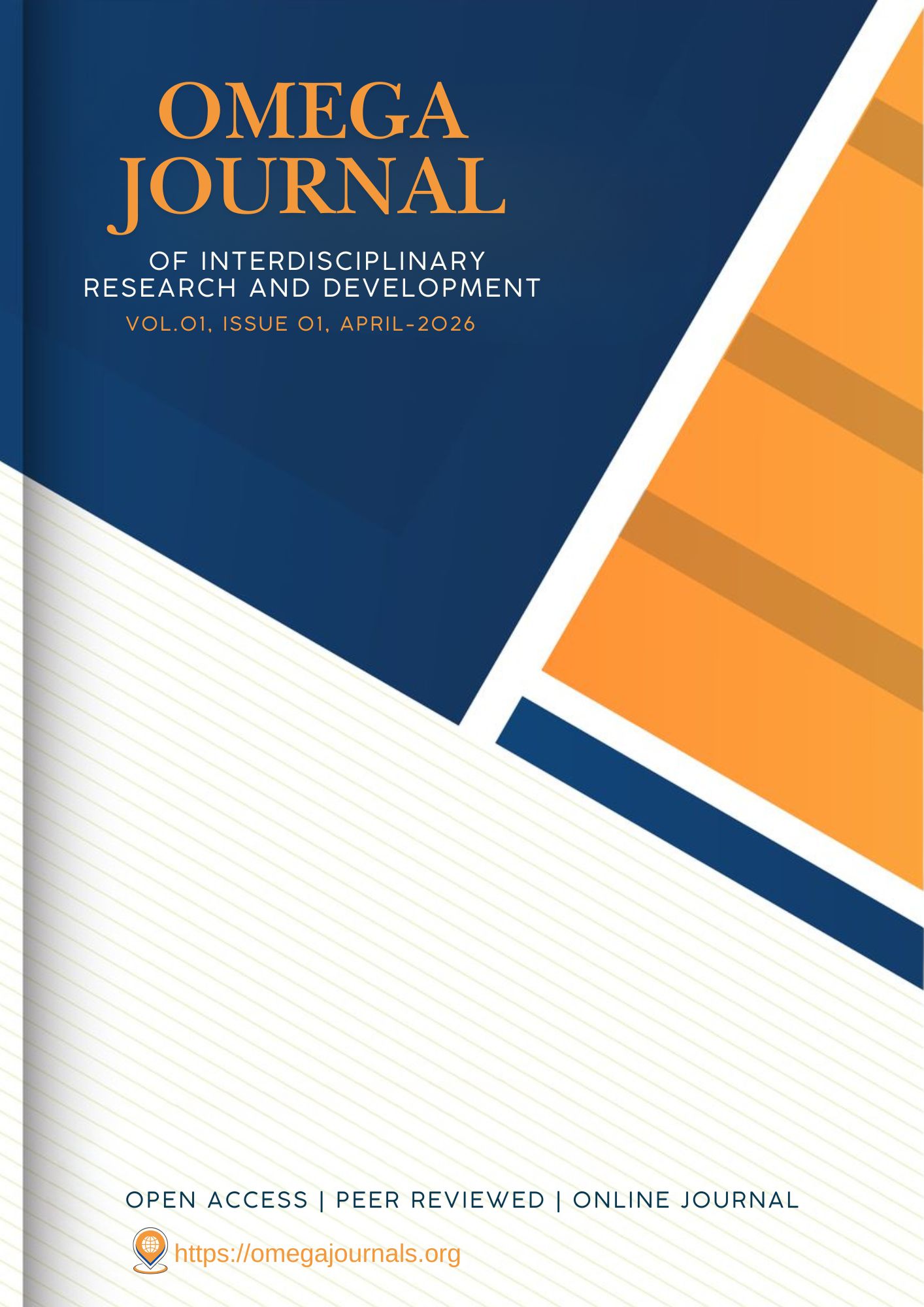
Published in Vol. 1 No. 1 (2026) of Omega Journal of Interdisciplinary Research and Development.
OMEGA Journal of Interdisciplinary Research and Development is an international, peer-reviewed, open access journal dedicated to promoting research that integrates knowledge across multiple disciplines. The journal provides a platform for scholars, researchers, and professionals to publish innovative and impactful research that contributes to academic advancement and societal development.
Key Highlights:
- Peer-reviewed (Double-blind)
- Open Access Journal
- Monthly Publication
- Multidisciplinary Scope
Frequency of Publication: Monthly
Languages: English, Polish and Russian
Publication Format: Electronic
ISSN (E): 3072-4708
About the JournalAbstract
The rapid digital transformation of higher education has emerged as a defining feature of contemporary academic systems. Simultaneously, sustainable development has become a central global priority, requiring systemic changes across institutions and societies. This study investigates the intersection of digital transformation and sustainable development within higher education through an interdisciplinary lens integrating educational theory, information systems, and sustainability science. Using a systematic literature review and comparative institutional analysis across European universities, the study develops a conceptual framework linking digital adoption to environmental, social, and economic sustainability outcomes. The findings reveal that digital transformation enhances accessibility, reduces environmental impact, and fosters innovation, while also presenting challenges related to digital inequality and governance. The paper concludes with policy recommendations for aligning digital strategies with sustainability objectives.
References
1. Bond, M., et al. (2020). Emergency remote teaching in higher education. International Journal of Educational Technology in Higher Education.
2. Crawford, J., Butler-Henderson, K., Rudolph, J., Malkawi, B., Glowatz, M., Burton, R., ... & Lam, S. (2020). COVID-19: 20 countries' higher education intra-period digital pedagogy responses. Journal of applied learning & teaching, 3(1), 9-28.
3. Dhawan, S. (2020). Online learning: A panacea in the time of COVID-19 crisis. Journal of educational technology systems, 49(1), 5-22.
4. Frodeman, R., Klein, J. T., & Pacheco, R. C. D. S. (Eds.). (2017). The Oxford handbook of interdisciplinarity. Oxford University Press.
5. Leal Filho, W., Will, M., Salvia, A. L., Adomssent, M., Grahl, A., & Spira, F. (2019). The role of green and sustainability offices in fostering sustainability efforts at higher education institutions. Journal of Cleaner Production, 232, 1394-1401.
6. Lozano, R., Barreiro‐Gen, M., Pietikäinen, J., Gago‐Cortes, C., Favi, C., Jimenez Munguia, M. T., ... & Gladysz, B. (2022). Adopting sustainability competence‐based education in academic disciplines: Insights from 13 higher education institutions. Sustainable Development, 30(4), 620-635.
7. Morley, J., Elhalal, A., Garcia, F., Kinsey, L., Mökander, J., & Floridi, L. (2021). Ethics as a service: a pragmatic operationalisation of AI ethics. Minds and Machines, 31(2), 239-256.
8. Selwyn, N. (2021). Education and technology: Key issues and debates. Bloomsbury Publishing.
9. Zawacki-Richter, O., Marín, V. I., Bond, M., & Gouverneur, F. (2019). Systematic review of research on artificial intelligence applications in higher education–where are the educators?. International journal of educational technology in higher education, 16(1), 39.
10. Outeda, C. C. (2024). European education area and digital education action plan (2021–2027): One more step towards the europeanisation of education policy. In E-Governance in the European Union: Strategies, Tools, and Implementation (pp. 187-206). Cham: Springer Nature Switzerland.
11. Bo, N. S. W. (2025). OECD digital education outlook 2023: Towards an effective education ecosystem. Hungarian Educational Research Journal, 15(2), 284-289.
12. Carney, S. (2022). Reimagining our futures together: a new social contract for education: by UNESCO, Paris, UNESCO, 2021, 186 pages, ISBN 978-92-3-100478-0 (Vol. 58, No. 4, pp. 568-569). Routledge.
Details
License
Copyright (c) 2026 Omega Journal of Interdisciplinary Research and Development

This work is licensed under a Creative Commons Attribution 4.0 International License.
You are free to:- Share — copy and redistribute the material in any medium or format for any purpose, even commercially.
- Adapt — remix, transform, and build upon the material for any purpose, even commercially.
- The licensor cannot revoke these freedoms as long as you follow the license terms.
- Attribution — You must give appropriate credit, provide a link to the license, and indicate if changes were made. You may do so in any reasonable manner, but not in any way that suggests the licensor endorses you or your use.
- No additional restrictions — You may not apply legal terms or technological measures that legally restrict others from doing anything the license permits.
You do not have to comply with the license for elements of the material in the public domain or where your use is permitted by an applicable exception or limitation.
No warranties are given. The license may not give you all of the permissions necessary for your intended use. For example, other rights such as publicity, privacy, or moral rights may limit how you use the material.